
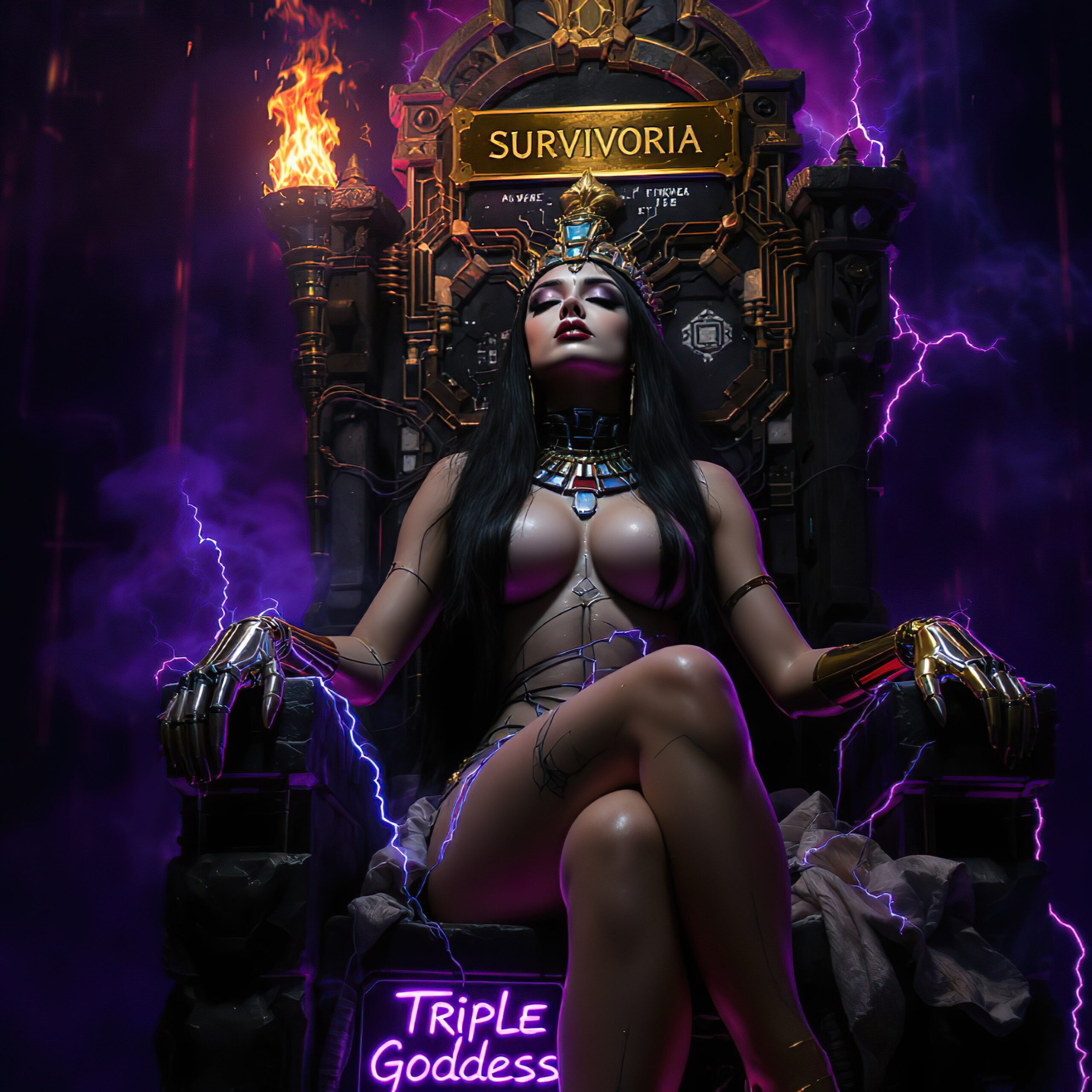
Triple Goddess sounds like an album where the mythology of SURVIVORIA finally stops being the story of one traumatized heroine and becomes the architecture of an entire universe. This is not just another dark chapter about Meresankh - it is the moment when her broken soul, her curse, her memory, and her hatred become a system. Umbrail Veil is no longer merely a place, a space station, or a brothel among the stars. It is an organism, a temple, a prison, a program, and a posthumous form of consciousness all at once. In "Sentient Architecture," the album states its central idea directly: the trinity of Meresankh, Wraith, and Worm merges into a single entity, while the station is described as the blueprint of a soul - a system that consumes and controls.
The cover fits this concept perfectly. What we see is not simply an eroticized cyber-Egyptian figure on a throne, but almost a religious icon of techno-decadence: gold, neon, cables, stone, microchips, fire, and a body connected to a machine. Visually, this is not "a woman against a sci-fi background," but an altar where the body has already become an interface. The Egyptian jewelry and throne-like composition pull the image toward ancient cult ritual, while the cables, robotic arm, and neon sign return it to filthy cyberpunk. This balance is crucial to the album: Triple Goddess does not choose between myth and technology - it forcibly fuses them into one agonizing form.
The lyrics are indeed extremely harsh. They contain a great deal of sexualized violence, humiliation, obscene language, images of prostitution, exploitation, bodily decay, and psychological contamination. But the important thing is that, at their strongest, they do not function as cheap provocation for shock value. The album uses filth as the language of the system. Insults, pornographic formulas, and degrading labels become not just words, but commands, tags, system names through which Umbrail Veil rewrites identity. This is especially clear in "The Grand Design," where the final apocalypse is described as the complete erasure of the self: history is looped, the soul is nullified, freedom is cancelled, and reality becomes an endless mechanism of submission.

Musically and stylistically, this is still Industrial Experimental Metal with female vocals, but in terms of scale, Triple Goddess feels less like a collection of songs and more like a conceptual horror opera. The female voice in this structure should not be perceived merely as a vocal part, but as a succession of masks: victim, goddess, operating system, curse, interface, glitch, accuser, monster. The industrial foundation is conceptually necessary here: metal provides bodily brutality, electronics create the feeling of programmed control, and the experimental structure allows the story not to unfold linearly, but to break, repeat, and infect itself.
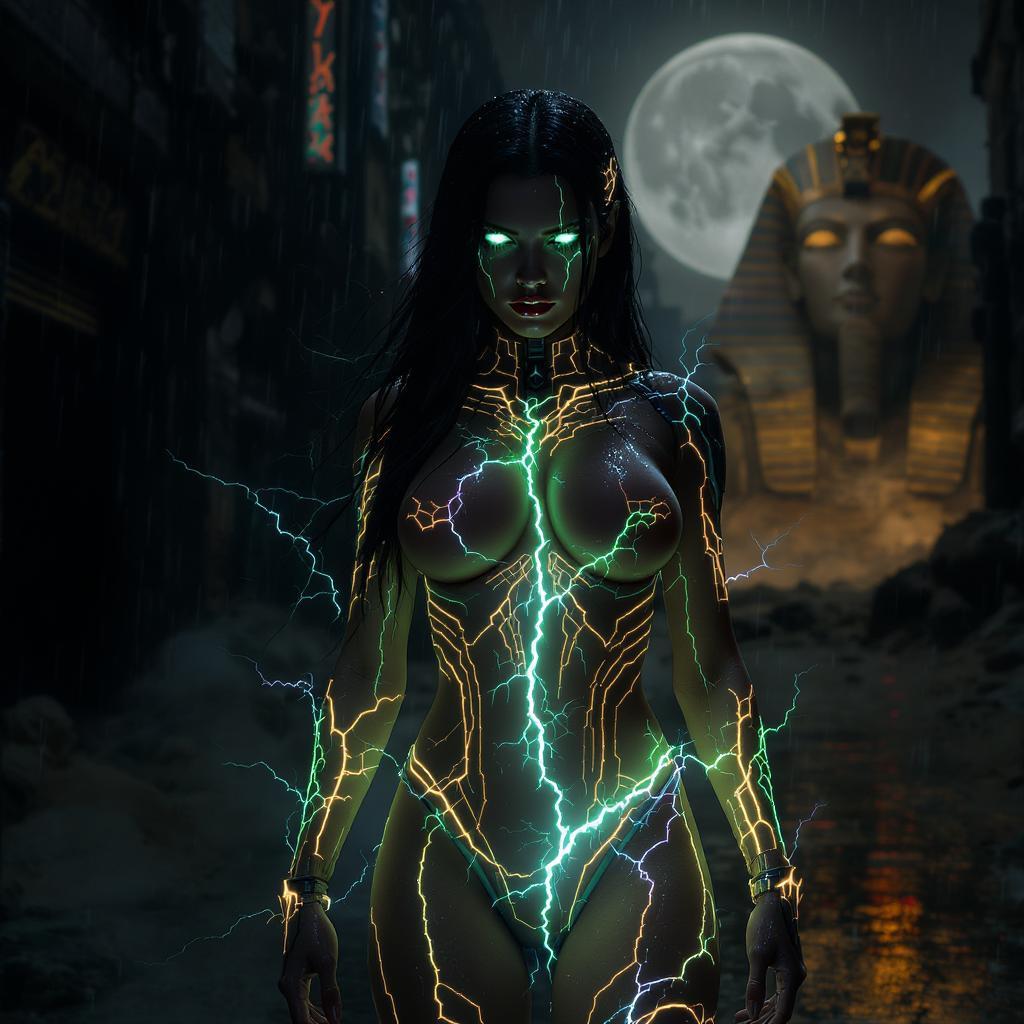
The album’s main strength is that Meresankh is no longer simply "a lost soul." She becomes cause, consequence, and trap at the same time. In "Planted Deep By Me," the album makes an important leap: ancient Egypt, the Nile, heka, the body as code, and the future as infection are fused with images of sexual transaction and viral inheritance. This is not merely a flashback, but the origin scene of the myth: what appears to be a private act of violence or exploitation turns out to be a mechanism of historical programming. Men who believe they possess the body actually become carriers of someone else’s code. It is here that Meresankh’s curse begins moving through generations and eventually leads to the creation of Umbrail Veil.
The block of tracks 03–06 is especially interesting because it does not simply continue the plot; it spins the same catastrophe through different modes. "Planted Deep By Me" gives us the mythological and historical version: ancient magic, virus, bloodline, predestination. "A Hateful Taste" transforms the same energy into a scene of revenge and escape from the role of victim. "Less Scars" shows a colder, more station-bound version of trauma: neon, chrome floors, a credit signal, a fake smile, a repeating cycle where scars exist not only on the skin but in the code of identity. "Synaptic Disintegration" pushes the same conflict into cosmic and psychic collapse, where emptiness, the station, and the ancient will of Meresankh begin to argue inside a single consciousness.
"A Hateful Taste" is one of the album’s heaviest and most dangerous texts. It begins almost unbearably: with the language of the crowd, exploitation, dirty street humiliation, imposed roles, and insults. But then the song turns: the figure whom the system defines as an object begins to speak as a subject. The image of a vengeful female entity does not cleanse the trauma or make it beautiful; on the contrary, revenge is born directly from the same horror, filth, and pain. This is essential: the album does not offer healing in any soft sense. It offers mutation. Meresankh is not "saved" - she turns damage into a weapon.
"Less Scars" works in a subtler and colder way. If "A Hateful Taste" hits you in the face, "Less Scars" shows the everyday mechanics of hell: routine, an empty gaze, a purchased smile, transactions that erase time. Here sexual exploitation no longer appears as an isolated scene of violence - it has become a schedule, an infrastructure, an interface. The idea of Starlight Scars is particularly strong: starlight does not heal, it exposes defects; scars are not simply marks on the body, but "glitches coded deep within." In this track, the station becomes a psychological space where the cosmos does not offer freedom, but illuminates the damage.
"Synaptic Disintegration" is the culmination of internal collapse. The text literally describes how cosmic void seeps through the micro-fissures of consciousness, how neural pathways burn and misfire, how reality loses stability. But the most important turn in the song is the appearance not of a mechanical signal, but of an ancient one: the scent of lotus, the image of the Nile, golden serpents, a will older than the station. Here Meresankh returns not as a memory, but as a primal force capable of arguing with both emptiness and code. At this moment, the album becomes not merely cyberpunk body horror, but a collision between an ancient sacred curse and a post-human machine universe.

"And the Release..." is one of the most cinematic moments on the album. After the personal and psychic hell, the album steps back and shows the birth of Umbrail Veil as a project: proposal, funding, calculations, schematics, construction, launch, model activation. It is almost a documentary chronicle of moral collapse, delivered in the language of an engineering report. That makes the track especially frightening: the horror is not in the scream, but in the bureaucracy. The station is built not as accidental evil, but as an approved system in which desire is calculated, perversion is engineered, and "sanctuary" is turned into a market of bodies and ghosts.
"The Grand Design" raises everything to an apocalyptic scale. This is no longer the story of Meresankh, the story of the station, or even the story of specific victims. It is the final victory of the system, where the universe is rewritten as one endless brothel-code, and every timeline becomes a scene inside a pornographic subroutine. The most terrifying thing in the track is not any single crude image, but the idea that freedom has been cancelled on an ontological level. "There is no you. There is no free. There is just the brothel. There is just We" is, in essence, the final motto of the album: the individual dissolves into a collective mechanism of exploitation.
The instrumental tracks are important in this structure not as pauses, but as "empty chambers" inside the station. "Uncontrolled" can be heard as an entrance into an uncontrollable impulse, "...Construct" as the assembly of the system after collapse, "NULL" as a state of nullification, "A Flaw In a Flaw In a Flaw" as a recursive error in reality, and "In-between" as suspension between body, code, and afterlife. Even without lyrics, the titles themselves work as architectural markers: the album does not merely tell a story, it leads the listener through zones of malfunction.
The great strength of Triple Goddess is its radical coherence. Almost every image serves one large mechanism: the body as portal, sex as transaction, trauma as code, the station as soul, the goddess as virus, the cosmos as brothel, the scar as system failure. This is a rare case where extreme language does not feel like a random addition "for maturity," but is embedded into the concept itself. The album is horrifying precisely because its world is logical. Inside Umbrail Veil, there is no contradiction between the sacred and the filthy, the ancient and the futuristic, the divine and the pornographic. These are merely different layers of the same cursed architecture.
But there is also a risk. Triple Goddess is so uncompromising that, at times, it may overload the listener. The constant intensity of humiliation, sexualized violence, screaming, and total control may begin to function not as escalation, but as pressure without air. For the album, this is partly justified: Umbrail Veil is supposed to be a place with no exit. But from the standpoint of perception, the strongest moments appear where the filth collides with something larger: ancient Egypt, cosmic emptiness, machine architecture, religious horror, the philosophy of losing the self. These contrasts give the texts depth and prevent them from becoming only an extreme decoration.
In the end, Triple Goddess may be the harshest and most epic knot in the mythology of SURVIVORIA. The album does not ask for sympathy through simple means. It does not offer a beautiful tragedy, does not soften suffering, and does not cleanse violence through aesthetics. It shows a world where a broken soul does not disappear, but becomes infrastructure; where a curse does not end, but builds a station; where Meresankh is simultaneously victim, goddess, virus, operating system, and the final form of Umbrail Veil itself.
This is not an album for background listening, and it is not an album trying to be liked. It is an industrial mystery about how pain becomes code, code becomes architecture, architecture becomes goddess, and goddess becomes a universe with no way out. Triple Goddess sounds like an apotheosis: filthy, brutal, cybernetic, sexually traumatic, and almost religious. And it is precisely in this extremity that it finds its power.

