
Survivoria delivers more than a music video here. "Dressed Like Blasphemy" plays like a five-minute act of bodily dystopia, where beauty becomes a contract, the dress becomes a parasite, and invisibility costs more than the mark it was meant to hide.
In "Dressed Like Blasphemy", Survivoria leans into an aesthetic that fits the frame of modern dark industrial metal with female vocals: cold laboratory surfaces, blue neon, glitching interfaces, filthy motel rooms, religious language, medical coercion, and an almost fetishistic precision in the way the body is presented as a battlefield. This is not a video that simply decorates a track with dark imagery. It feels like a complete visual chapter in the Survivoria world, where lyric, protagonist and setting are locked inside the same cruel machine.
From the first seconds, the video speaks in the language of systems. The Survivoria logo appears, followed by near-black exposition screens about Relay, an institution that seems to rename mercy as governance and governance as salvation. Before the protagonist fully enters the frame, the video has already made one thing clear: this will not be a private drama floating in empty space. The body is already inside politics, technology and ritual.
When the protagonist stands before microphones under The Relay sign, the video states its central idea with brutal clarity. This is not a rock heroine striking a stylish pose. This is a body at a press conference. The blue-purple mark glowing in her lower abdomen reads as diagnosis, public evidence and brand at once, something that cannot be hidden from cameras. The lyrical desire to make the blue go grey stops being an abstract metaphor. In this world, the blue is what the city, medicine, police, press and market all know how to read.
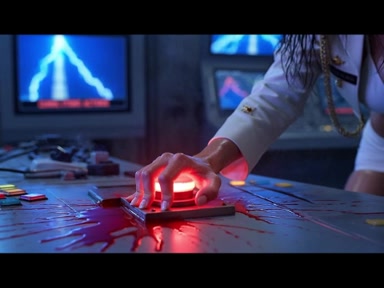
From there, "Dressed Like Blasphemy" moves like a clinical nightmare. A red button on a blood-smeared control desk, a ruined city, scanning beams, close-ups of face and skin, laboratory interfaces: all of it builds a world where being visible means being broken down into data, shame and price. The protagonist does not simply live in the city. She passes through its recognition system.
Against that background, the black dress first appears to offer rescue. It promises what the city never allowed her: the chance to pass through the gaze without being decoded. During the chorus, the video turns this into the image of a black prayer across the body. But Survivoria refuses to romanticize the transformation. The black cloth does not arrive as freedom. It arrives as product, procedure and transaction. The white-coated doctor, armed personnel, tablets, money on a plate, motel rooms and medical tables quickly explain the bargain: invisibility is being sold by the same hands that put her on display.
That is the strongest dramatic line in the video. "Dressed Like Blasphemy" is not a simple transformation story in which the heroine puts on a dark look and becomes empowered. Instead, the clip shows, step by step, that the new image also knows how to possess the body. The black strips first resemble clothing, then restraints, then living tendrils, then a spider-like organism. The dress stops being costume and becomes anatomy.
That is where the horror lands. The blue mark was external: visible, measurable, socially legible. The black cloth is worse because it works from within. It grants the protagonist a brief experience of disappearance, but it takes memory, name, skin, breath and autonomy in return. Visually, the video is blunt, sometimes almost aggressively literal, but that bluntness is part of its force. The symbols are not coy. Beauty is paid for in blood, and the pretty thread really does cut.
The middle section is crucial to the video's ambition. Where many clips would settle for sexualized dark imagery, Survivoria widens the frame into social horror. Rows of similarly dressed women appear in an industrial setting; a crude selection sign turns the body into inventory; screens command "COPY / COMPLY / CONFESS"; walls repeat "Obey." The protagonist's personal story becomes a production model. The system does not merely exploit one woman. It manufactures a version of femininity that can be copied, sold, disciplined and renamed liberation.
This is where the clip becomes more than body horror. It becomes a critique of aestheticized control. To be "beautiful" in this world is to be fit for duplication. To be "invisible" is to become convenient to the system. To feel, for one sweet minute, like a woman rather than a warning is tragically brief: a moment of relief for which the body will later be billed.
The final chorus raises the stakes into something almost religious. The red ruined city, the black parasite in the palm, the clones, the close-ups of skin and mouth all turn the dress into an anti-sacred object. The title "Dressed Like Blasphemy" works in two directions at once. The protagonist appears as blasphemy against Relay's public liturgy because she tries to exit the regime of visible branding. But the dress itself becomes a new liturgy: a black cathedral cut to fit the body, demanding its own sacrifices.

The coda after the final lyric is especially effective. The video does not end when the words do. It keeps showing the consequences: the doctor, an audience of officers and administrators, the black organism as exhibit, a nearly intimate exchange of infection through the mouth, then the protagonist holding a gun beside the system's representative. Even this possible moment of resistance does not read as a clean victory. It remains inside the laboratory architecture, inside the same theatre of control.
The final image is an overhead view of a dark room, a filthy bed and a figure curled into a black cocoon. It is neither liberation nor simple defeat. It is the state after the bargain. She hid the brand, but the brand did not leave. It changed color, shape and depth.
As a music video, "Dressed Like Blasphemy" is strongest in its cohesion. Its imagery can feel overloaded: laboratory, body market, religious symbols, neon, spider-like biology, post-apocalyptic city, clones and obedience slogans sometimes hit the viewer with very little air between them. But for dark industrial metal, that pressure feels less like a flaw than a feature. The genre can thrive on compression, mechanical image-rhythm, cold aggression and the feeling of a system that leaves no clean space to breathe.
The eroticized visual language may be the most debatable aspect. The video critiques the body being turned into a commodity, but at points it walks so close to that edge that viewers may have to decide where exposure of the gaze ends and reproduction of the gaze begins. Still, the structure holds the meaning in place. These images do not offer pleasure without consequence. They keep returning the bill: money, medical table, seams, restraints, clones, blood, loss of name.
Ultimately, "Dressed Like Blasphemy" feels like one of those videos that serves the mythology of a project rather than just promoting a song. It is dark, unpleasant, dense and conceptually committed: a video about the desire to vanish from someone else's gaze, and about the fact that systems know how to sell even disappearance. Visually, this is modern dark industrial metal in one of its most bodily forms: not just steel and neon, but steel grown into skin.
Verdict: harsh, visually coherent and hard to shake off. Its power is not shock for shock's sake, but the way it follows its central metaphor all the way down: the dress does not save the protagonist from the brand. It becomes the brand that has learned how to wear her.